After designing traditional e-commerce platforms like PetSmart.com and spending years working in the direct sales space—including three complete redesigns of PlexusWorldwide.com—I’ve learned that these two models require fundamentally different design approaches.
Many designers assume e-commerce is e-commerce. They’re wrong. Direct sales (also called social marketing or network marketing) has unique requirements that traditional e-commerce platforms simply don’t address. Understanding these differences is critical to designing experiences that actually work.
The Fundamental Difference
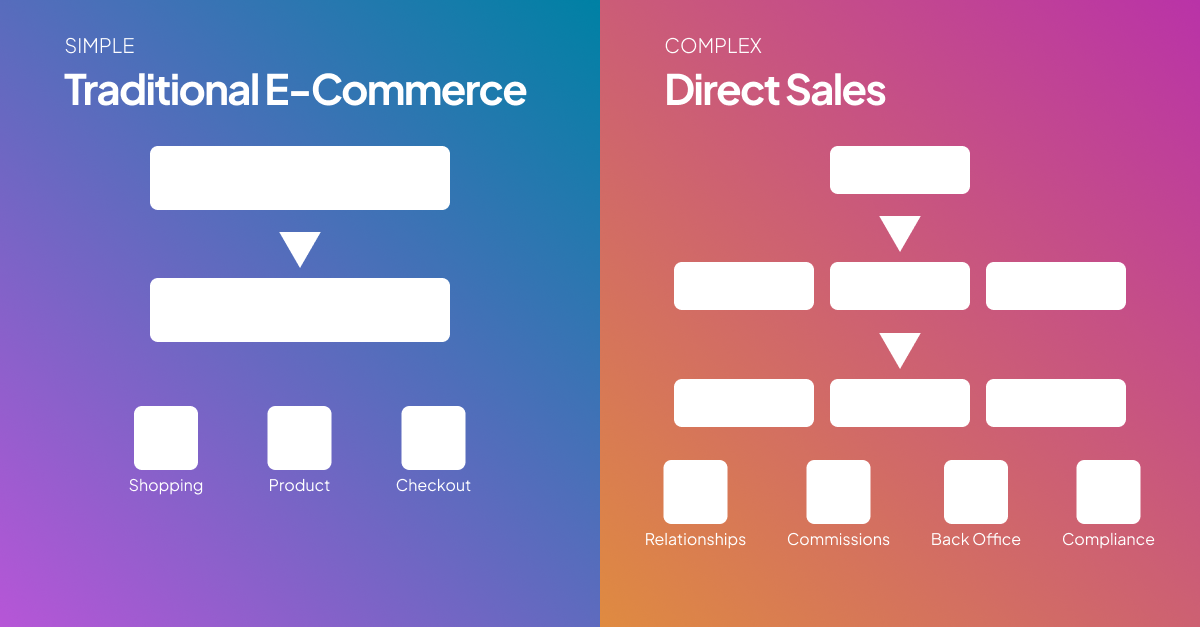
Traditional E-Commerce: Company → Customer
Direct Sales: Company → Distributor → Customer
That extra layer changes everything.
Why This Matters for Design
When I redesigned PetSmart.com, the challenge was straightforward: help customers find products, make purchasing easy, and create a seamless checkout experience. It’s still complex, but the user journey is relatively linear.
With PlexusWorldwide.com—which I’ve redesigned three times as the business evolved—the complexity multiplies exponentially. You’re not designing one experience; you’re designing an ecosystem where multiple user types interact with different goals, permissions, and workflows.
Key Differences Every Designer Should Understand
1. Multiple User Types with Different Needs
Traditional E-Commerce:
- Customers (browse, buy, track orders)
- Admin staff (manage inventory, process orders)
Direct Sales:
- Retail Customers: Purchasing products one-time or on subscription
- Distributors: Selling products, building teams, earning commissions
- Preferred Customers: Loyalty program members with special pricing
- Corporate Admins: Managing the entire network
- Compliance Teams: Ensuring legal and regulatory adherence
Each user type needs different features, dashboards, and workflows. During my three redesigns of PlexusWorldwide.com, we continuously refined these experiences as the business model evolved and new user types emerged.
2. Relationship-Based Shopping
Traditional E-Commerce: Anonymous shopping is the default. PetSmart.com doesn’t care if you found them through Google, an ad, or word of mouth—the experience is the same.
Direct Sales: The distributor-customer relationship is central to everything. When someone clicks a distributor’s link to PlexusWorldwide.com, that relationship must be:
- Captured and maintained throughout the session
- Displayed clearly (who their distributor is)
- Protected (competitors can’t steal customers)
- Respected in all communications
This means:
- Personalized landing pages
- Distributor search and verification flows
- Replicated websites for each distributor
- Complex cookie and session management
- Relationship validation at checkout
3. Commission and Compensation Complexity
Traditional E-Commerce: Revenue goes to one company. Simple.
Direct Sales: Every sale triggers a cascade of commission calculations across multiple levels of an organization. Your design must accommodate:
- Real-time commission previews: Distributors need to see their earning potential
- Rank advancement visualization: Progress toward the next level
- Team performance dashboards: Tracking downline sales
- Bonus qualification tracking: Meeting monthly requirements
- Payout history and projections: Financial planning tools
None of this exists in traditional e-commerce. When redesigning PlexusWorldwide.com, building the distributor back-office—with all its commission tracking, team management, and reporting features—was often more complex than the customer-facing storefront.
4. Enrollment vs. Purchase
Traditional E-Commerce: Checkout is checkout. On PetSmart.com, you add items to cart, enter shipping and payment, and you’re done.
Direct Sales: Two completely different checkout flows:
Retail Checkout: Similar to traditional e-commerce, but must maintain distributor relationship and offer enrollment incentives.
Enrollment Flow: A multi-step process that includes:
- Choosing between customer and distributor enrollment
- Selecting enrollment packages or starter kits
- Agreeing to autoship terms (recurring subscriptions)
- Signing agreements and compliance documents
- Setting up back-office accounts
- Configuring commission settings (for distributors)
- Payment for both initial order AND monthly autoship
This isn’t just a longer checkout—it’s a fundamentally different process that requires careful UX to prevent abandonment. In my work on PlexusWorldwide.com, optimizing the enrollment flow was always the highest-impact design challenge.
5. Product Bundling and Pack Strategy
Traditional E-Commerce: Products are usually purchased individually. PetSmart.com lets you add one bag of dog food, one toy, one leash—whatever you need.
Direct Sales: Product “packs” or “bundles” are strategic tools:
- Enrollment Packs: Special bundles for new members
- First Order Incentives: Discounted bundles for first-time customers
- Rank Qualification Packs: Bundles that help reach volume requirements
- Promotional Packs: Limited-time offers with special commission rates
The UI must clearly explain:
- What’s in each pack
- Why this pack vs. individual products
- How it affects commission/points
- Time-limited availability
- Qualification requirements
6. Compliance and Legal Requirements
Traditional E-Commerce: Standard e-commerce regulations, return policies, and terms of service.
Direct Sales: Highly regulated industry with FTC oversight and state-by-state regulations:
- Income Disclaimers: Required on any page mentioning earnings
- Autoship Disclosure: Clear explanation of recurring charges
- Right to Cancel: Prominent cancellation policies
- Product Claims: Carefully controlled language about results
- Testimonials: Specific attribution requirements
- Distributor vs. Company: Clear distinction in communications
Every redesign of PlexusWorldwide.com required close collaboration with compliance teams. What seems like a minor copy change can have legal implications. This level of regulatory constraint doesn’t exist in traditional e-commerce.
7. Replicated Websites
Traditional E-Commerce: One website serves all customers.
Direct Sales: Every distributor gets their own “replicated” website—essentially a personalized version of the main site with:
- Distributor’s name and photo
- Custom URL (usually a subdomain)
- Tracking for all traffic and sales
- Distributor’s contact information
- Personalized welcome messages
- Their specific product recommendations
Designing a system that serves potentially thousands of replicated sites while maintaining brand consistency, performance, and functionality is a unique challenge. The architecture decisions here are critical.
8. The Back Office
Traditional E-Commerce: Customers get an order history page. That’s about it.
Direct Sales: The distributor back office is essentially a complete business management platform:
- Dashboard: KPIs, goals, team performance
- Team Genealogy: Visual organization chart of downline
- Commission Reports: Detailed earnings breakdowns
- Sales Tools: Marketing materials and resources
- Training Center: Product education and business building
- Inventory Management: For distributors who stock products
- Customer Management: CRM for their customer base
- Autoship Management: Controlling recurring orders
- Rank Advancement: Progress tracking and requirements
- Events Calendar: Company events and team meetings
This is a full business intelligence platform that needs to be intuitive for users with varying technical skills.
Real-World Lessons from Three PlexusWorldwide.com Redesigns
Over three complete redesigns of PlexusWorldwide.com, here’s what I learned:
Redesign #1: Foundation
The first redesign focused on establishing the core direct sales functionality:
- Separating customer and distributor experiences
- Building the enrollment flow
- Creating the basic back office
- Implementing replicated websites
Key Learning: You can’t iterate your way to a direct sales platform. The architecture must be right from the start, or you’ll be rebuilding constantly.
Redesign #2: Optimization
The second redesign refined the experiences based on real usage data:
- Streamlined enrollment to reduce abandonment
- Enhanced the back office with better reporting
- Improved mobile experiences
- Added social features for team building
Key Learning: Direct sales users are power users. They’ll use your platform daily, sometimes for hours. Performance and efficiency matter more than visual polish.
Redesign #3: Scale
The third redesign addressed growth challenges:
- International expansion with multiple currencies and languages
- Advanced commission structures and bonuses
- Integration with external tools (CRM, email marketing)
- Enhanced compliance features for regulatory changes
Key Learning: Direct sales platforms must be built for scale from day one. Adding features later that affect commission calculations or user hierarchies is extremely difficult.
Common Mistakes Designers Make
1. Applying E-Commerce Patterns to Direct Sales
Just because it works on Amazon doesn’t mean it works in direct sales. The user journey is fundamentally different.
2. Underestimating Complexity
“It’s just e-commerce with commissions” is a dangerous assumption. The complexity is exponential, not additive.
3. Ignoring the Distributor Experience
If your distributors can’t easily manage their business, they won’t sell your products. The back office is just as important as the storefront.
4. Poor Relationship Management
Losing track of distributor-customer relationships destroys trust and causes commission disputes. Get this right or everything else fails.
5. Overlooking Compliance
Regulatory issues can shut down the entire business. Compliance can’t be an afterthought.
Why Traditional E-Commerce Experience Matters
My experience with PetSmart.com taught me the fundamentals:
- Conversion optimization
- Checkout flow best practices
- Product discovery and search
- Performance optimization
- Mobile-first design
- Accessibility standards
These fundamentals still apply to direct sales. But they’re just the foundation. Direct sales requires an additional layer of complexity that most e-commerce designers never encounter.
The Hybrid Approach
The best direct sales platforms balance both worlds:
From Traditional E-Commerce:
- Fast, intuitive shopping experience
- Clear product information and imagery
- Streamlined checkout
- Responsive design
- Performance optimization
From Direct Sales Requirements:
- Relationship management
- Multiple user types and permissions
- Commission tracking and reporting
- Compliance and regulatory features
- Business management tools
What This Means for Your Design Process
If you’re designing a direct sales platform:
1. Invest in Discovery Understand the compensation plan thoroughly. Attend company events. Talk to distributors at all levels. The business model drives everything.
2. Design Systems Are Critical With so many user types and workflows, inconsistent patterns become chaos fast. Establish a robust design system early.
3. Involve Compliance Early Don’t design features that compliance will veto later. They’re stakeholders, not blockers.
4. Test with Real Users Distributors will use your platform in ways you never imagined. Test early and often with actual users at different experience levels.
5. Plan for Scale From day one, think about international expansion, multiple languages, complex commission structures, and high-volume transactions.
6. Focus on the Distributor Tools If distributors succeed, the company succeeds. Their experience is just as important as the customer experience—maybe more so.
Conclusion
Traditional e-commerce and direct sales platforms serve different business models and require different design approaches. My experience with both PetSmart.com and three redesigns of PlexusWorldwide.com taught me that success requires understanding not just interface design, but the business model itself.
The distributor relationship, commission structures, compliance requirements, and business management tools make direct sales platforms exponentially more complex than traditional e-commerce. But when designed well, they empower thousands of independent entrepreneurs to build businesses while providing customers with personalized service that traditional e-commerce can’t match.
If you’re approaching a direct sales project with only e-commerce experience, take time to understand these differences. The patterns you know are valuable, but they’re only the starting point. The real challenge—and opportunity—lies in solving the unique problems that make direct sales platforms their own category.
The next time someone says “it’s just e-commerce,” you’ll know better.